Getting Started with 2Do for Mac
This tutorial walks you through setting up 2Do for Mac and gives you a tour of every meaningful feature in the app: capture, organization, scheduling, focus, search, sync, and the small touches that make daily use feel right. Each section is brief; click through to the dedicated page when you want the full reference.
Introduction
2Do is a flexible personal task manager for macOS. It scales from a simple list of errands to a full GTD-style planning system, and it's been carefully shaped by years of feedback from professionals, students, and lifelong list-keepers. There's no wrong way to use it: keep it a one-list scratchpad or push it into deep multi-project territory, and the same tools sit a click away either way.
2Do's main features include:
- Lists and List Groups: color-coded lists you can group, lock, archive, or keep out of All and Today.
- Projects, Checklists, Sub-tasks: combine simple tasks with structured outcomes.
- Multiple Windows: open several independent windows, each with its own selection, search, and layout.
- Widgets: put any list on your desktop or in Notification Center, and tick tasks off without opening the app.
- Quick Entry: capture system-wide, even when 2Do isn't running (powered by the 2Do Alarm Helper).
- Natural Language Input: type a new task the way you'd say it and 2Do fills in the date, time, repeat, tags, and the rest.
- Mail to 2Do: a private email address for your Mac; anything sent to it becomes a task.
- Quick Open: jump to any task or list from a Spotlight-style search.
- Smart Lists and Smart Filters: saved searches that behave like real lists; an extremely powerful filter syntax lives behind the search bar.
- Tags, Tag Groups, and Pausing: context tools you can switch on and off in seconds.
- Markdown notes: format notes in Markdown, with auto-detected links and inline date stamps.
- Link tasks together in notes: type
@{...}to cross-reference any task; links resolve by title, even across your devices. - Work with Claude (Co-Work): let Claude create, update, and organise your tasks through 2Do's built-in automation server.
- Multi-Task Actions: defer, schedule, share, or move many tasks with drag-and-drop, menus, and shortcuts.
- Redesigned alarms with repeating sound: reminders that can keep nudging until you notice them.
- Calendar events in your lists: see your Apple Calendar day above Today, or keep it in view across all your lists.
- Import from other apps: bring tasks in from Things, OmniFocus, or a calendar file.
- Sync your way: Dropbox, iCloud CalDAV, Custom CalDAV, Todoist, Apple Reminders, or Toodledo, with WebDAV coming soon. Pick what fits and stay.
- Share Lists over Wi-Fi: publish a list to other 2Do users on your local network.
- Backup restoration browser: selectively restore individual lists from any backup.
The Walkthrough Tutorial
The first time you open 2Do, a short walkthrough introduces the parts of the window and the ideas behind them.
It isn't a one-time thing either: Help > Walkthrough Tutorial reopens it whenever you want, so you can come back to it once you've used the app for a week and the later sections mean more.
Permissions
After installing 2Do (from the Mac App Store or the direct trial), open the app and start using it. macOS asks for access when a feature needs it:
- Notifications: used for task alerts and reminder windows.
- Location Services: used when you add locations or use Nearby.
- Calendar / Reminders Access: Calendar access is used when you show calendar events above your lists. Reminders access is used when you sync with Apple Reminders.
- Contacts: used by Actions when you attach contact-based calls, messages, emails, addresses, or URLs to a task.
If you deny a permission by mistake, open System Settings > Privacy & Security or System Settings > Notifications, find 2Do, and enable the access you need.
Choosing How You Sync
2Do treats sync as your bridge between devices, never a requirement to keep your data with us. Sync lives in one place: open 2Do > Settings > Sync > Setup and pick a provider from the Account Type pop-up.
Pick the method that fits you:
- iCloud: recommended. Syncs through the iCloud account you are already signed in to, with no separate password. Everything syncs, including Smart Lists, tags, tag groups, list groups, locations, and attachments.
- Dropbox: carries nearly every task property, plus List Groups, Tag Groups, Smart Lists, and Search Presets.
- Apple Reminders: your tasks show up in Apple's Reminders app while 2Do keeps your projects and sub-tasks intact.
- Todoist: sync tasks, projects, tags, dates, durations, and starred status with your Todoist account.
- Toodledo: for the Toodledo ecosystem; some features map with caveats.
- iCloud CalDAV: Apple-hosted CalDAV sync. Requires an Apple Account app-specific password.
- Fastmail: its own entry in the Account Type picker; sign in with your Fastmail address and an app password.
- Yahoo and Fruux: built-in CalDAV entries of their own, each needing only a username and password.
- Custom CalDAV: ownCloud / Nextcloud, Synology, and any other CalDAV server.
- WebDAV: coming soon: sync to your own WebDAV server as plain files you control; everything syncs.
If 2Do lives on a single Mac, you can leave the Account Type set to None.
For how 2Do reconciles the two sides the first time you connect, and the rule that keeps you on one account at a time, see Sync below.
If you use 2Do on iPhone, iPad, and Mac, make sure all devices use the same sync method. Mixing methods leads to disconnected data on each side.
Importing and Exporting
Moving to 2Do from another app? File > Import brings your tasks in:
- From Things… and From OmniFocus…: read your existing database directly (these menu items appear only when the app is installed), mapping areas/projects, tasks, checklists, tags, dates, reminders, and repeats as closely as possible.
- Calendar File (.ics): import the tasks (VTODO items) from any calendar file into a list you choose.
Coming from Todoist or Reminders? There's nothing to import: set up two-way sync under Choosing How You Sync above and your tasks stay connected in both apps.
File > Export sends your data back out:
- Calendar File (.ics): export selected lists and their tasks as a standard calendar file.
- Spreadsheet (.csv): export as a spreadsheet for a quick review or archive.

The 2Do Window
The Mac app is built around a familiar three-pane layout:
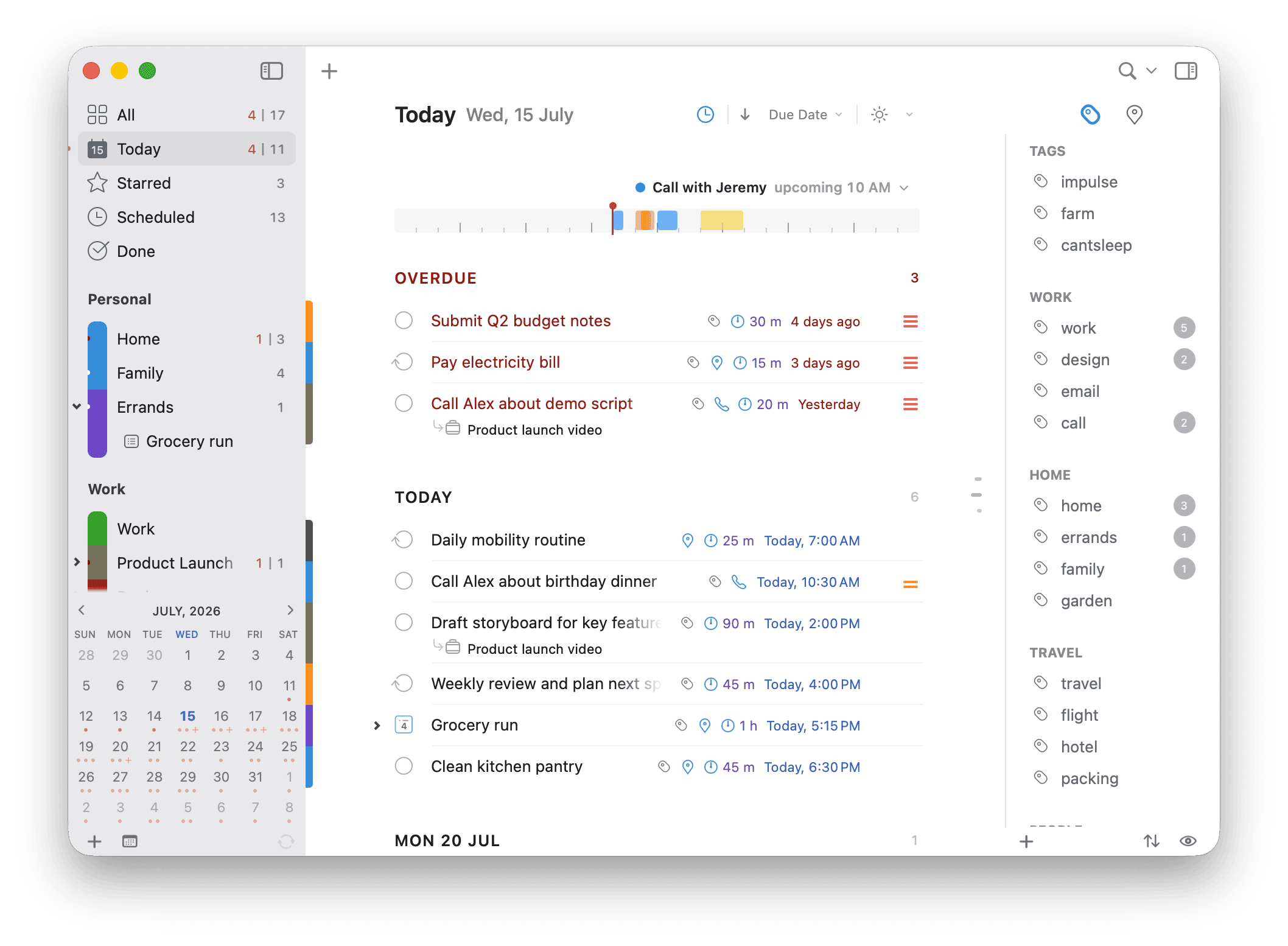
- Lists Panel (left): your lists, list groups, Focus Lists, and Smart Lists, with the mini calendar at the bottom. 2Do auto-collapses this panel when the window gets narrow and re-expands it when there's room again.
- Task List (centre): the tasks inside the selected list, with the Sort Bar at the top.
- Utility Panel (right): contextual helper with Tags and Locations buttons at the top.
Hide the Lists Panel via View > Hide Lists (⌥⌘←, or the Toggle List Panel button), and the Utility Panel via View > Hide Tags (⌥⌘→), when you want a focused, single-pane view.
For a deeper anatomy of each part of the window, see The 2Do Window.
The Toolbar
The toolbar gives you one-click access to the most-used commands: New Task (with a dropdown for New Project and New Checklist), the Global Search Bar, Sync, and the Utility Panel toggle.
The Sort Bar
Just below the toolbar sits the Sort Bar, a single strip holding several controls:
- Current list name on the left, with a briefcase button that toggles Project View when a project or its sub-task is selected.
- Click the current list name to open the List Jump Bar and jump to any list, project, or checklist by name. In a focused project, clicking the name exits Project View instead.
- On the right: a scheduled-visibility toggle (clock icon) for revealing tasks hidden by Smart Scheduling, the sort method dropdown with an ascending/descending arrow, and the Focus Filter toggle.
Each list remembers its own sort and Focus settings.
Mini Calendar
A compact month calendar lives just below the Lists Panel, and scrolls from one month to the next. It does more than display the date:
- Busy days: days with tasks starting or due are marked with a color tint that deepens as the number of tasks rises (Heat Map, the default), with small Dots, or not at all, set under Settings > Appearance > Mini Calendar. Future occurrences of repeating tasks are marked too, so a glance shows what's coming.
- Click a day to filter the Task List to that day; click again to clear. Clicking a busy day in the future shows exactly which tasks land on it, including upcoming repeats.
- Click and drag across days to filter to a date range.
- Drag a task onto a date to defer it. The calendar appears if it was hidden, and holding the task over the top or bottom weeks moves to the previous or next month.
⌥-click any date to create a new task with that day as its due date.
Search and Jump Bars
2Do has four distinct find surfaces, each tuned for a specific kind of "find me this" moment:
- Global Search Bar (
⌘F): filter the task list with Smart Filter syntax; save the filter as a Smart List. - Task Find Bar (bare
F): jump the selection to a task by title without filtering. - List Jump Bar (bare
J): jump to a list in the sidebar by name. - Tag Search Bar (bare
/): find a tag in the Tags panel by name.
See the dedicated Search and Jump Bars page for the full breakdown.
Collapsing Task Sections
When the Task List is grouped into sections (by date, priority, list, and so on), ⌘-click a section header to collapse or expand all sections at once. 2Do remembers each section's collapsed state per list, so a list you like tidy stays tidy.
Section Heat Bars
Whenever a list has more than one section, a slim rail of heat bars runs along the task list's right edge: one small bar per section, its length reflecting how many tasks the section holds. Rest the pointer on a bar for the section's title and count, and click (or drag along the rail) to jump straight there. See Section Heat Bars.
Show Last Selected Task
Lost your place after jumping around? View > Show Last Selected Task (⇧F5) returns you to the last task you had selected, switching lists or focused projects as needed and revealing the task even if a Focus Filter or search would normally hide it. Press it again to keep stepping backward through recently selected tasks.
Multiple Windows
Open as many independent windows as you like with File > New Window (⌃⌥⌘N), or right-click the Dock icon and choose New Window. A new window starts as a clone of the active one, then goes its own way.
Each window keeps its own selection, search field and scope, scroll position, window size, and panel visibility, so you can keep a project open in one window while triaging your Inbox in another. Extra windows persist and reopen the next time you launch 2Do. (A list's sort order and Focus Filter belong to the list itself, so two windows showing the same list share those.)

Appearance
2Do ships with a range of themes and follows your Mac's system appearance automatically. In 2Do > Settings > Appearance, a Light / Dark switcher at the top lets you choose which theme 2Do wears in Light mode and which it wears in Dark mode; the app then swaps between them whenever macOS changes. To keep a single look all the time, assign the same theme to both slots. Appearance is set per device.

Widgets
2Do's widgets keep your tasks in view without the app in front of you. Put them on the desktop (macOS 14 and later) or in Notification Center, and they refresh as your tasks change.
- List (small, medium, large): the tasks of any one list you pick, including Focus Lists and Smart Lists, with live overdue and remaining counts in the header. Medium and large add a floating
+button for capturing a task; large can also show due dates and each task's home list. - Today: a medium widget fixed to your Today list, with a calendar day tile beside what's on for the day.
Click a task to jump to it in 2Do, or click its checkbox to complete it right on the widget (medium and large widgets, macOS 14 and later). To change what a widget shows, right-click it and choose Edit "2Do"….
Lists and List Groups
There are three kinds of lists in 2Do, each shown in the Lists Panel:
- Focus Lists (built-in): All, Today, Starred, Scheduled, Done. Saved perspectives across all your tasks.
- Lists: your own, holding tasks, projects, and checklists. Color-coded, optionally grouped, optionally locked.
- Smart Lists: saved searches that behave like real lists.
Inbox sits above the Focus Lists when Getting Things Done® Inbox is turned on. It's a real list of its own, not a Focus List.
Create a list with File > New > New List or the [+] button at the bottom of the Lists Panel. Each list has a name, a color, a sort order, a Focus rule, and an optional lock. List colors help you spot where a task belongs when several lists are shown together in All or Today.
To organize related lists, create a List Group via File > New > New List Group. Drag lists into it and collapse the group when you don't need to see what's inside.
Counters Next to List Names
Each list shows two counters:
- Undone (right): number of dated or undated tasks, projects, and checklists not yet completed. Sub-task counts appear on the project / checklist icon, not the list.
- Overdue (left, red): tasks past their due date.
The counts animate (digits roll like a number wheel when a value changes), and you choose what they show under Settings > Today & Lists > Counts (None, Overdue items, or Overdue + Undone). Values above 999 show as 999+.
A single glowing dot can also appear on a list row: white when the list has tasks due today, red when it has overdue tasks (red wins when both apply). The dot never appears on the All, Done, or Scheduled rows. A lock icon indicates a locked list.
The Disclosure Triangle
If a list contains projects or checklists, a small disclosure triangle appears next to the list icon. Click it to reveal every project and checklist inside the list; clicking any of them highlights it directly in the task list.

Excluding a List from Focus Lists
Some lists shouldn't contribute to All or Today: Someday lists, archives, recurring chores you only want surfaced by their alarms. Right-click a list in the Lists Panel and choose the matching Include in... or Exclude from... option for All, Today, or Done. A small visibility indicator appears next to the list name once any toggle is on.

Hiding Unwanted Lists
Distinct from Lock and Exclude, you can also hide lists from the sidebar entirely (including built-in Focus Lists you never use). Open 2Do > Settings > Security > Privacy, where the List Visibility section shows a switch for every list; turn a list off to hide it. On Dropbox sync, this preference syncs across devices.
Archiving a List
Finished with a list but not ready to delete it? Right-click it and choose Archive List; it steps out of your active workspace and can be restored any time from 2Do > Settings > Security > Archived. See Archiving a List.
Getting Things Done® Inbox and Default Capture List
Two related options under 2Do > Settings > Tasks, in the New Tasks section:
- Getting Things Done® Inbox: when on, Inbox is your true capture surface; new tasks from Quick Entry and the share extension land there for triage. While it's on, Always Use Default List is switched on for you and can't be changed.
- Always Use Default List: every new task goes to the chosen default list regardless of which list was selected when you created it.
For more, including the indicators that appear next to a list name, see Lists and List Groups.
Focus Lists
The top of the Lists Panel always shows your Focus Lists:
- All: every task across every list, except those hidden by a paused tag, scheduled to start in the future, or in a list excluded from All.
- Today: tasks due today, plus tasks whose duration window covers today. Depending on your Today & Lists settings, Today can also include overdue tasks, starred tasks, and tasks you are still working on.
- Starred: every starred task.
- Scheduled: tasks with a future start date currently hidden by Smart Scheduling.
- Done: completed tasks.
Above them sits the optional Inbox, which appears once Getting Things Done® Inbox is turned on. It's a real list where new captures land for triage, not a Focus List.
Use ⌘1–⌘5 to jump between All, Today, Starred, Scheduled, and Done. Use ⌘0 for the Inbox when it's enabled. For the per-list deep dive, including each list's exact membership rules, see Focus Lists.
Calendar Events in Your Lists
2Do can show your Apple Calendar day right above your tasks, so appointments and tasks sit side by side. Out of the box the events appear above Today; turn on Show Calendar Events in Lists and they stay in view across your regular lists and Focus Lists too. Set it up under 2Do > Settings > Calendar: grant Calendar access, pick where the bar appears, and uncheck any calendars you'd rather leave out (new calendars are included automatically).
The events are read-only (2Do displays them but never edits them), and the bar stays out of Project View, Smart Lists, and search. A small toggle inside the bar switches between a compact timeline and an expanded day view.

Tasks, Projects, and Checklists
2Do has three task types that work together:
- Task: a single standalone item. Can carry notes, tags, dates, alerts, location, an action, and sub-tasks.
- Project: a parent for related tasks. Each child carries its own properties (dates, alerts, tags) and shows up individually in Focus Lists.
- Checklist: a parent for items that only matter together. Children cannot carry their own dates (they inherit scheduling from the checklist), though they can carry tags; the whole checklist behaves as one item in Focus Lists.
Create with File > New > New Task (⌘N), New Project (⌥⌘N), New Checklist (⌃⌘N), or New Sub-Task (⌃⌥N). Convert between types via Task > Convert at any point.

Project View
When you're inside a project, Task > Toggle Project View (⌥⌘J) collapses everything else and leaves only the project's tasks. Useful when you want to work on one plan without the rest of the list in view.
Project / Checklist from Selection
Select a handful of existing tasks → right-click → New > Project from Selection (or Checklist from Selection). The selection becomes children of a new parent.
For more, see Projects and Checklists.
Task Completion Feedback
When you mark a task done (or undone) from the task list, 2Do plays a short completion sound; toggle it under Settings > General > Sounds > Play task completion sounds (on by default).
Clear a list entirely and its empty state shows a short celebration: confetti, balloons, fireworks, a trophy, and other randomized animations (the Starred list adds a shooting star). Cleared search results and empty Smart Lists stay quiet, so celebrations only mark real "all done" moments.
The Task Editor
Every task in 2Do can carry a rich set of details, all visible in the editor:

- Title and notes: the headline and any free-form context. Notes support Markdown, auto-detected links, and inline
@{…}links to other tasks. See Notes, Markdown, and Links. Drop in timestamps via Edit > Insert Time Stamp or the notes toolbar's Insert Date & Time chip. - List selector: move the task between lists from inside the editor.
- Start date and Due date: type a natural date or time straight into the field (each has a date segment and a time segment with autocomplete), or pick from the dropdown. Type None to clear a date, No Time to clear just the time.
- Due time and Duration: a specific deadline and an estimated length.
- Priority: set from the priority button at the right of the task row, which opens a small menu ordered None / High / Medium / Low, plus Star.
- Tags: comma-separated; new tags created on the fly, with autocomplete as you type.
- Location: a place on the map, useful for the Locations panel's Nearby view and for location alerts on iPhone and iPad.
- Action: turns the task itself into a click: Call, Message, Mail, Visit, URL, Google.
- Alerts: one or many, relative to dates or fixed to a specific date and time, with optional sound.
- Recurrence: repeat with flexible rules.
- Attachments: pictures, audio notes, file links.
The editor opens inline, so you can keep your place in the task list while filling in the details you need. For the full reference, see The Task Editor.
Copying and Linking a Task
The editor's top-bar Copy chip opens a menu with more than a plain copy:
- Copy: the full task, same as
⌘C. - Copy Title / Copy Notes: just the text you want.
- Copy Embeddable Link: the task's
@{Title}token; paste it into another task's notes for a live inline link. - Copy Shareable Link: a
twodo://deep link that reopens this exact task.
Editor Shortcuts and Picker Presets
While editing, set priority without touching the mouse: ⌥⌘0/⌥⌘1/⌥⌘2/⌥⌘3 for None / Low / Medium / High, and ⌥⌘S to toggle the star. You can also jump straight to a field's picker: ⌘; (Recurrence), ⌘' (Alerts), ⌘B (Action), and more.
Once a picker is open, press ⌥1–⌥6 to choose a preset instantly. Each chip shows its own ⌥N hint: in the Recurrence picker ⌥1 is Daily and ⌥2 is Weekly, and in the Alerts picker ⌥2 adds a "5 minutes before" reminder.
Quick Look: Preview Without Opening
Press Spacebar with a task selected and a redesigned Quick Look panel shows the full multi-line title, Markdown-rendered notes, dates, alarms, attachments, a prominent action card, and (for projects / checklists) a percentage-of-completion bar. The panel stays open as you step through the list with the up/down arrow keys, refreshing live, and its own copy menu mirrors the editor's. Press Spacebar again or ⌘W to close.
Hover Priority and Star
You don't have to enter edit mode to change priority or star a task: hover the mouse over the right side of any task row and the priority button appears. Click it for a small menu ordered None / High / Medium / Low, plus Star.
Natural Language Input
Type a new task the way you would say it. 2Do marks the details it recognizes with a soft capsule and fills in their fields as you type. A tag you type appears after you add a space, leave the title, or save. The detected text is taken out of the title when you save, along with helper words such as starting that lead into it.
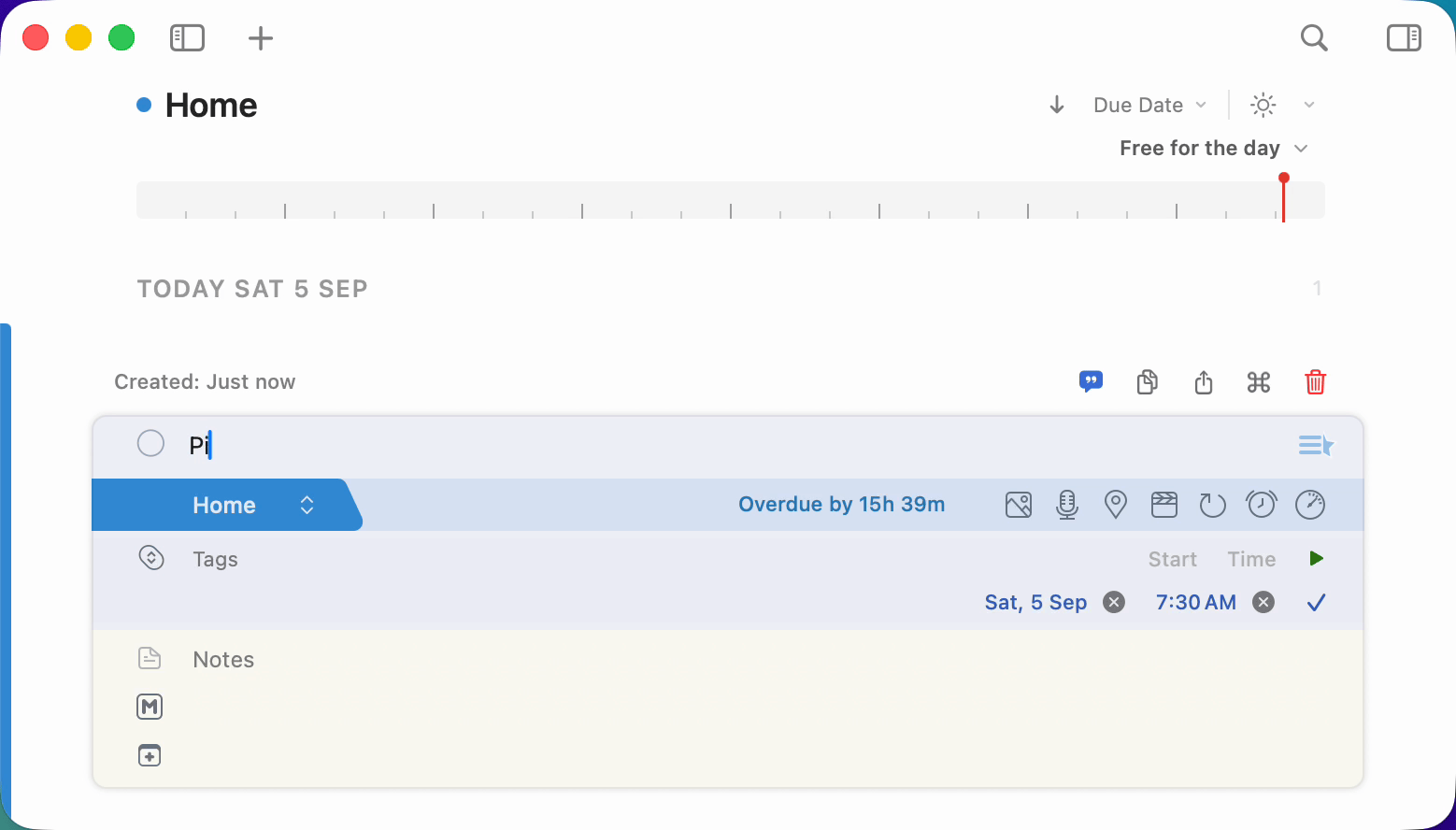
Pack the school bag tomorrow at 7pm #family
=> due tomorrow 7:00 PM, tag family

Renew the passport on 5 September !!!
=> due 5 September, High priority

Tidy the desk every weekday at 5pm
=> due the next weekday at 5:00 PM, repeats Monday to Friday

Home repairs from 19 July until 21 July
=> starts 19 July, due 21 July

Post the letters /errands
=> saved to the Errands list
A date on its own is the due date. A start word such as starting, starts, begins, or from in front of a date sets the start date instead, and it can lead a range so the task gets a start and a due date in one line.
Dates, times, start dates, ranges, repeats, alerts, durations, priority, stars, tags, lists, and locations you have already saved can all be typed this way, in any of ten languages. Each language has its own supported words and word order, so not every everyday phrase is recognized. Turn it on or off per surface under 2Do > Settings > Tasks > New Tasks, or for a single task from the chip in the editor's top bar.
Notes, Markdown, and Links
Task notes are more than a plain scratch area. Markdown is styled live as you type (bold, italics, headings, lists, quotes, code, strikethrough, and links), and the Markdown Preview chip flips the notes into a clean rendered view with clickable links. The underlying text you save stays plain Markdown, so nothing is locked into a proprietary format.
2Do also finds every URL, email, and file path in your notes; the Open Links in Notes chip lists them all, and Insert Date & Time stamps the current date or time at the caret in any format you like.

Linking to Other Tasks
Notes can point at other tasks. Type @{ in any note and a picker opens at the cursor: leave it empty to see your recent tasks, or keep typing to filter by title, then press Return to insert an @{Title} link. Click that link later and 2Do jumps to the task in its list. The editor's Copy Embeddable Link chip puts the same token on the clipboard for whichever task you have open.
A link is only the task's title, not a hidden identifier, so you can type one by hand on any device and it resolves everywhere your notes sync: Blocked by @{Order parts} written on your iPhone is already live when you reach your Mac. The trade-off is that titles are what get matched, so give tasks you link to distinctive names.
Dates and Durations
A task in 2Do has up to three time-shaped properties (Start Date, Due Date, and Duration), each independently optional. Together they decide when a task is visible, when it's hidden as Scheduled, and how far in advance 2Do should remind you about it.
- Just a Due Date: appears in Today on the day, then becomes overdue until you complete it.
- Just a Start Date: hidden until the start date arrives, then appears in the list.
- Start + Due: hidden before start, visible during the working window, surfaces in Today on the due date.
- Due + Due Time + Duration: the duration creates an effective start time before the deadline. A task due at 3:00 PM with a 30-minute duration becomes active around 2:30 PM.
- Due + Duration: the duration acts as a date-only lead-up window, useful for tasks that need preparation before the due date.
Tasks with a future start date are hidden by Smart Scheduling; reveal them via the Scheduled Focus List, the clock icon on the Sort Bar, or Task > Show Scheduled (⌘K).
A due date with no due time has no specific clock time attached. If you'd like new dated tasks to inherit a preferred time of day automatically, set a Default Due Time under Settings > Tasks.
You can also type dates straight into the title of a new task, including start dates such as starting Monday: see Natural Language Input.
Learn more: Dates and Durations.
Stars and Priorities
Two ways to mark a task as more important, with deliberately different jobs:
- Star: I want this in front of me right now. Personal, ephemeral, easy to flip on and off. The Starred Focus List collects every starred task.
- Priority: This task is intrinsically important. Stable, ordered (None / Low / Medium / High). Priority drives sort order and is a first-class field in Smart Filters.
Set priority with bare 0/1/2/3 (when the Task List has focus), =/- to increase/decrease, or by clicking the priority button at the right of a task row and picking from its menu (None / High / Medium / Low, plus Star).
For the decision tree on when to use which, see Stars and Priorities.
Quick Entry
Quick Entry is 2Do's system-wide capture window. Press ⌃⌘Space (the default hotkey, changeable under 2Do > Settings > General) from anywhere on your Mac to bring up a focused editor. Keep Launch 2Do Alarm Helper on System Startup enabled; the Helper powers Quick Entry and 2Do's alarms, and keeps both working even when 2Do isn't running.

- Uses the same task editor style as the main app, with the fields you need for fast capture.
- Optionally appears centred above the currently focused window for multi-monitor setups.
- Drag and drop files onto the 2Do dock icon to open Quick Entry pre-filled with a file link.
- Share selected text or a web page from another app with Add to 2Do (the Share or Services menu) to open Quick Entry pre-filled.
- Within 2Do,
⇧⌘2opens Quick Entry without the global hotkey. - Type the task the way you'd say it and Natural Language Input fills in the date, time, tags, and more as you go.
For more, see Quick Entry.
Pasting Multiple Tasks at Once
Copy a chunk of text from another app (bullet points from an email, lines from a document), paste into 2Do (⌘V), and one task is created per non-empty line. With a project or checklist selected first, they become sub-tasks of the parent.
Mail to 2Do
Give your Mac its own private, receive-only email address: anything sent to it lands in 2Do as a task. Forward a flight confirmation from your phone, send yourself a thought from the office, or point an automation at it; the subject becomes the title and the plain-text body becomes the notes. Subject instructions like due(tomorrow), priority(!!!), list(Work), and tag(home) file the task as it arrives, and a body of numbered lines becomes a checklist.
Enable it under 2Do > Settings > Mail to 2Do (the pane appears when your license is eligible). Mail is encrypted for this Mac the moment it arrives and deleted as soon as the task is delivered.

Quick Open
Quick Open is a Spotlight-style jump box for your whole task database. Press ⇧⌘O (or Edit > Quick Open...) and a search panel drops into view, ready to type.
Leave the field empty and it lists your recently modified tasks and recently accessed lists; start typing and it matches tasks and lists by title. Press Return to open the top hit: a task jumps to and focuses itself in its list, a list simply switches to it. It's the fastest way to reach something without hunting through the sidebar.
Quick Open is distinct from Quick Entry, which creates a new task, and from the Search Bar, which filters the current view in place. Quick Open is a transient overlay that jumps you anywhere in the app and then dismisses.

Tags
Tags attach context to a task without depending on which list it's in.
- Common patterns: GTD contexts (
home,phone,waiting), people, energy levels, status flags. - Group related tags into Tag Groups for tidier management.
- Filter the Task List by clicking a tag in the Tags panel; click more tags to combine them, and click again to remove one from the filter.
- Click the eye chip at the bottom of the Tags panel to narrow the panel to the tags used by the tasks currently on screen; click it again to show every tag.
- Sort a list by Tag and each section header shows the task's full tag set as readable, comma-separated tag names (untagged tasks gather under No Tags).
Showing and Hiding Tag Names
By default, tag bubbles appear right on each task row. Prefer a cleaner list? Turn off Settings > Appearance > Task List > Always show tag names and the bubbles hide behind a small indicator; hold Option (⌥) any time to reveal them while held.
Pausing a Tag
Any tag can be paused. When a tag is paused, every task carrying that tag is hidden from view automatically: All, Today, list views, search. Paused tags stay in your library; only their tasks change visibility.
Show paused tasks without resuming the tag via Task > Show Paused (⌘U) or Task > Show Scheduled & Paused (⇧⌘K).
For more, see Tags.
Smart Lists, Smart Filters, and Search
A Smart Filter is anything you can describe in 2Do's search bar: a keyword, a tag query, a date range, a combination. A Smart List is a Smart Filter that's been saved as a permanent entry in the sidebar.
The same search engine powers the Global Search Bar and Smart Lists, with two modes:
- Soundex: sound-alike matching, so plumver can find plumber, Steven can find Stephen, and alexnder can find Alexander.
- Full Text: precise matching with exclusions,
OR, and wildcards. For example,new jobrequires both words,new job -findexcludes find, andnew*matches words like new, newer, and newest.
Reserved keywords let you build structured filters: type: (priority, dates, action types, attachments, status, structure), tags:, taggroups:, locations:, lists:, groups:, and modified: / created: / completed:. lists: limits (or, with !, excludes) tasks by list name, searching across every list regardless of what's selected, while taggroups: pulls in every tag under a named Tag Group. Combine tokens with AND, or place a standalone OR between them for alternatives:
type: hiprio AND duethisweek tags: !waiting
type: overdue OR tags: urgent
Save with the [+] button next to the search field. Common Smart Lists: This Week, Stalled, Waiting On, High Priority, Errands Nearby.
By default, opening a project or checklist keeps your active search or Smart List applied to its sub-tasks. Turn Settings > Today & Lists > Inherit Search off if you'd rather see a project's full contents unfiltered.
For the complete reference and recipe library, see Smart Lists, Smart Filters, and Search.
The Focus Filter
The Focus Filter switches a list between everything it holds and only the tasks matching the conditions you pick. Click the Focus button in the Sort Bar (or press ⌘J) to toggle it on. Each list remembers its own focus choices.
The Focus Filter uses a built-in condition menu: for example High Priority, Today, This Week, or Starred. For more detailed filters such as a specific tag or location, save a Smart List.
For more, see Focus Filter.
Multi-Task Actions
Select multiple tasks (⌘-click or ⇧-click), then act on the whole selection with the keyboard:
D: Defer the selection by a relative offset.K: Schedule the selection to a specific date.T/Y: Set Due Today / Due Tomorrow.S: Star the selection;⌃Sto unstar.0/1/2/3: Set priority None / Low / Medium / High.L/⌥L: Tag / Untag.M: Move to another list.⌘D: Duplicate.
You can also drop the selection on a list in the sidebar (move; ⌥ to copy), on Today (set due today), on Scheduled (opens the schedule picker), on Starred (star), on Done (complete), on a tag in the Tags panel (apply tag), or on a date in the mini calendar (set due date). Smart Lists do not accept drops; they're virtual.
For date changes across several selected tasks, use D or Task > Defer... to open the batch date dialog and shift the selection together.

Move To and Copy To
Right-click a selection and the task menu offers Move To ▸ and Copy To ▸ submenus that list every eligible list, grouped just like the sidebar. A list that holds projects or checklists expands into a nested submenu, so you can drop the selection straight into a specific project or checklist as sub-tasks. Just-moved tasks surface together at the top or bottom of their sort group (depending on the sort direction) so you can see where they landed.
For more, see Multi-Task Actions.
Sharing Tasks
Two ways to send a copy of tasks elsewhere:
- Edit > Copy (
⌘C): plain text representation. Paste into Mail, Notes, Messages. - Task > Share: the macOS Share menu with the selection bundled (Mail, AirDrop, Messages, etc.).
For a single task, drag it from the task list onto the Desktop and 2Do writes a .twodo file carrying its full detail; another 2Do user can drop that file onto the Dock icon to import it. Right-click a selection and choose Export Selection to CSV... to send just those tasks to a spreadsheet. See Importing and Exporting.
Sharing is one-way; recipients get the task content, not a live link. To keep a list in sync with other 2Do users on your network instead, see Share Lists over Wi-Fi.
Repeating Tasks
Make any task repeat with flexible rules:
- Presets: Daily, Weekly, Every 2 weeks, Monthly, Quarterly, Yearly (
⌥1–⌥6while the rule is still Never). - Custom: every N days/weeks/months/years, or specific days of the week, or a given weekday of each month (the second Tuesday).
- End conditions: never, after N occurrences, on a specific date.
The most important choice: Repeat from Due Date vs Repeat from Completion. The first is for fixed schedules (rent on the 1st); the second is for chores that restart when you finally do them (change your car's oil every 3 months, water the plants every few days).
For more, see Repeating Tasks.
Alarms and Repeating Sound Alerts
A task can carry one alert or many, relative to its due date or start date, or fixed to a specific date and time. Alerts can also play a sound.
2Do offers two delivery methods, chosen in Settings > Alerts under Notifications method:
- 2Do (default): redesigned alarm cards that stack in the top-trailing corner of whichever display your pointer is on. Each card shows the task title, when it fired, its list, notes teaser, action, and tags, and can keep playing its sound until you dismiss it. The Sound alerts repeat until dismissed row under 2Do > Settings > Alerts (General tab, 2Do Notifications section) sets the interval: Never, Every 2 mins (the default), Every 5 mins, or Every 10 mins. The stack is draggable, and because alarms are delivered by the 2Do Alarm Helper, cards fire even when 2Do itself isn't running.
- Notification Center: alerts appear alongside other apps and are managed by macOS.
Each 2Do alarm card carries buttons to Complete, Close, Snooze, Open the task, or perform its action. The snooze menu offers 5 minutes, 15 minutes, 1 hour, This evening, and Tomorrow morning, with the last two showing the exact time they'll land on.

Automatic Alerts
Under Settings > Alerts > Default Reminders, 2Do can add a reminder to dated tasks for you automatically:
- Remind me of tasks with a due time: fires at the due time, or an offset before it like 5 minutes before.
- Remind me of tasks with a due date: for tasks without a due time, fires on the due date (midnight) or an offset before it.
To silence 2Do's alarm cards while a macOS Focus is on, see macOS Focus Filters. For more on alerts, see Alarms and Nagging.
macOS Focus Filters
macOS 13 and later let apps hook into Focus modes. Add 2Do to a Focus in System Settings > Focus > (your Focus) > Focus Filters > Add Filter > 2Do, turn on Silence 2Do Alarms, and 2Do's custom alarm cards stay hidden and silent whenever that Focus is active. Anything that fires while suppressed is held back and revealed when the Focus ends.
Prefer a blanket rule? Settings > Alerts > Silence custom alarms during any Focus does the same thing for every Focus, without adding a per-Focus filter. Either way, this affects only the 2Do alarm method; it's separate from the in-app Focus Filter that hides non-matching tasks in a list.
Actions
Every task can carry an Action that turns the task itself into something you can do:
- Call: open the Mac's call handler for a saved number or contact.
- Message: SMS / iMessage.
- Mail: pre-fill a new email.
- Visit: open an address or saved map location in Apple Maps.
- URL: open a link in your default browser.
- Google: run a web search using saved search text.
Click the action button on the task row (or press P) to perform it.
For more, see Actions.
Nearby and Locations
Attach a location to a task and 2Do becomes context-aware:
- The task can appear under Nearby in the Locations panel.
- The address is one click away in Apple Maps.
- The same location can sync to iPhone and iPad for Nearby Alerts.
The Locations panel is where you create and manage locations, with a Nearby selector inside it. Open the utility panel on the right, then click its Locations button at the top. Drag a location onto a task to assign it, or assign it directly from the editor.
For more, see Nearby and Locations.
Sync
Providers and setup are covered in Choosing How You Sync above. Once you are connected, sync behaves like this:
- 2Do keeps a single active sync account at a time; connect one, then click Change Account if you ever need to switch (Dropbox uses Link Account / Unlink).
- Each provider's What syncs across your devices panel spells out exactly what travels and what "stays on this Mac."
- When both this Mac and the account already hold user data, 2Do asks how to reconcile the two sides: Replace Local Data, Replace Server Data (not offered for Todoist or Apple Reminders), or Merge (matches items where it can and keeps both copies when something was created independently on each side; available for every method, but slow with a large number of tasks).
- A master Enable Sync switch turns syncing on or off, a per-device Sync automatically switch lets you sync manually when you prefer, and the Exclusions tab keeps chosen lists out of sync entirely.
For setup details and provider-specific caveats, see Sync.
When 2Do asks whether to Replace Server Data or Replace Local Data, pause and choose carefully. Use Replace Local Data when the cloud already has your latest tasks, and Replace Server Data only when this Mac has the data you want to keep. Choose Merge only when you are unsure, or when both sides hold changes you need to keep; it can take a very long time with many tasks. See Merge vs Replace.
Share Lists over Wi-Fi
Sometimes you don't need a cloud account; you just want to share one list with someone sitting on the same network. 2Do can publish a list so that other 2Do users nearby can subscribe to it and stay in sync directly over Wi-Fi.
Right-click a list and choose Publish List to LAN…, optionally make it read-only, and keep the 6-digit passcode on to control who joins. Other 2Do users open Window > Browse LAN Sharing, find your Mac in the Shared Lists window, and subscribe; a live copy lands in their sidebar. One list can serve many subscribers, and edits sync back when you allow read-write access.
Sharing works across Mac, iPhone, and iPad. For the iPhone and iPad side, see Share Lists over Wi-Fi.

List sharing works over your trusted local network and requires macOS 13+ on both ends plus the macOS Local Network permission. The passcode is the only gate; treat published lists as visible to anyone on the same network who has the code. The publishing Mac must stay awake and on the network for others to reach it.
Backups
2Do automatically backs up your local database on a schedule you choose (every 24 or 48 hours) and makes a safety backup before a Replace Local Data sync. Use Save a Copy… (from a backup's ⋯ menu in Settings > Backups) to keep an extra copy in iCloud Drive, Dropbox, or another safe location.
Restore from 2Do > Settings > Backups. Open a backup's ⋯ menu > Restore… (or Restore from File…) to launch the restore browser, where you can pick individual lists to bring back. Restore Selected is non-destructive; it duplicates the chosen lists (regular lists and Smart Lists) into a new Restored group without touching your existing data. Restore Everything… does a full destructive restore and relaunches the app.
2Do has no trash or recycle bin. Deleting a task removes it straight away, so ⌘Z is your immediate undo and a backup is the way back after that. See Recovering Deleted Tasks.
For more, see Backups.
Password Protection
Lock individual lists or the whole app behind a password; Touch ID is supported on capable Macs. Locked lists stay hidden until you unlock them. Auto-lock can lock 2Do again after a chosen period of computer inactivity.
For more, see Password Protection.
Notifications and Overdue Alerts
Beyond per-task alerts, 2Do's counts and overdue sections make missed deadlines visible. If you want an alert when a task reaches its due date, use a task-specific alert or automatic due-date / due-time alerts under Settings > Alerts. The glowing dot on a list row flags a list holding tasks due today (white) or overdue (red). See Alarms and Nagging for the alert options.
Printing
2Do can print neatly formatted task lists, useful for team meetings, fridge-door checklists, or genuinely offline days. File > Print... (⌘P) opens a preview of the current list with a few choices beside it:
- Tasks: All Tasks in the list, or just the Selected Tasks you highlighted before printing.
- Include Sub-tasks: print the children of projects and checklists, not only their parents.
- Include Notes: add each task's notes under its title.
- Include Tags: print each task's tags.
- Font Size: Small, Normal, or Large.
The preview updates as you change them, so you can see the page before committing paper to it. File > Page Setup... (⇧⌘P) sets paper size and orientation.
Siri and Shortcuts
2Do ships native actions for the macOS Shortcuts app: Create Task with dates, tags, alarms, recurrence, and structured sub-tasks, Find Tasks with property filters, Get Tasks from Collection, Set Task Completion, Move Tasks, Delete Tasks, Set Tag Paused, and more. Drag them together in Shortcuts with no scripting, run them from any trigger Shortcuts can fire (or by name with Siri), and they work even while 2Do isn't running. The classic twodo:// URL scheme remains available for callback-style flows.
For more, see Automate with Shortcuts, Siri and Shortcuts, and URL Schemes.
Work with Claude (Co-Work)
2Do ships a built-in MCP server, so AI agents running on your Mac can work with your live tasks. Claude Co-Work, the Claude Desktop extension, is the first-class way in: Claude can browse your lists, query tasks, create and update tasks, build projects and checklists, pause a tag, and open a task in the 2Do window. Ask it for the ten tasks due soonest, or hand it your travel plans and let it write the packing checklist.
Install the extension in Claude Desktop, keep 2Do running while you work, and unlock any password-protected list before you ask about it. Nothing travels over the network: the extension talks to 2Do's own local automation socket, the same engine behind Shortcuts and AppleScript, so any MCP-capable agent can drive 2Do too.
URL Schemes and Automation
The twodo:// x-callback-url scheme can create tasks, open lists, run searches, mark tasks complete by UID on Mac, and return task identifiers to Shortcuts or other automation tools.
For richer Mac automation, use the native Shortcuts actions or AppleScript Automation. Both share the same stable task automation API as the MCP server behind Claude Co-Work, covering listing, creating, updating, moving, completing, and opening tasks.
Email is a capture pipe too: Mail to 2Do turns anything sent to your private address into a task. iPhone and iPad have the same feature, each device with its own private address; see Mail to 2Do for iPhone and iPad. Tasks created that way sync onward like any other task.
For the complete URL reference, see URL Schemes.
Keyboard Shortcuts
A handful that pay for themselves quickly:
| Shortcut | Action |
|---|---|
⌘N | New Task |
⌥⌘N | New Project |
⌃⌘N | New Checklist |
⌃⌥N | New Sub-Task |
⌃⌥⌘N | New Window |
⇧⌘2 | Quick Entry (within 2Do) |
⌃⌘Space | Quick Entry (system-wide; changeable in Settings > General) |
⇧⌘O | Quick Open |
⌘J | Toggle Focus Filter |
⌥⌘J | Toggle Project View |
⌘. | Mark As Completed |
S / ⌃S | Star / Unstar |
D / K | Defer / Schedule selected tasks |
T / Y | Set Due Today / Due Tomorrow |
0/1/2/3 | Set Priority None / Low / Medium / High |
= / - | Increase / Decrease Priority |
⌘F | Find (Global Search Bar) |
F / J / / | Task Find / List Jump / Tag Search Bar |
⌥⇧⌘F | Find Options |
⌘0–⌘5 | Jump to Inbox or a Focus List (All, Today, Starred, Scheduled, Done) |
⇧F5 | Show Last Selected Task |
Spacebar | Quick Look |
⌘S | Sync |
⌘P |
For the full reference, see Keyboard Shortcuts.